Showing posts with label Irrfan Khan. Show all posts

Monday, July 22, 2013

Alternative history enters Hindi cinema

Film: D Day

Director: Nikhil Advani

Let us keep aside the coincidence that D Day released on a dry day, and focus on the coincidence of how Rishi Kapoor's character of Goldman resembles Dawood Ibrahim. But apart from playing it safe by not naming the character after the real life kingpin, Nikhil Advani gets his basics right. From using verbal and non-verbal codes that convince you who the man really is, D Day takes you on a journey no Hindi film has embarked upon.


The film opens with a R&AW team consisting of Wali Khan, Rudra Pratap, Zoya and Aslam (Irrfan, Arjun, Huma and Akash Dahiya) undertake the cohort mission (Operation Goldman) of striking at a wedding to seize India's most wanted criminal. The film then takes you backwards and counts down to how they all came to be in one place. Developing every character's back story without playing to the gallery at any given point, the film makes you root for the foursome.

Why D Day is an important film is that it introduces a genre in Hindi cinema previously unknown. Although we have had plenty of historically inaccurate films, cinema about alternative history (like Inglorious Basterds) has never really been made. In doing so, the film shows you things you had never dreamt of seeing.

Unlike Once Upon A Time In Mumbaai and Shootout At Wadala, where we are indirectly introduced to the Bhai in the past, and unlike films like D, Shootout at Lokhandwala and others, where he is simply shown as a shadow who runs the show while safe in his house in Dubai; D Day imagines Goldman as he is today - wise and frail with age. From the red aviators that never leave his face to each and every dialogue he mouths, the film tries to give an insider's perspective on the don.

The complex flow of events is simplified, but not over-simplified and keeps you interested in the proceedings. Huma Qureshi and Arjun Rampal stick to their characters and are pretty convincing. Irrfan Khan as Wali Khan would steal the show on any given day, but comes second to a phenomenal show put up by Rishi Kapoor. Adding a little royal demeanour to his Rauf Lala from Agneepath, he (with a decent contribution of the makeup) has you convinced that you are seeing the man who has terrorised this country for over two decades.

Playing to its strengths, the film is entertaining through and through. A few action sequences are very well choreographed but there are some that appear just too choreographed and leave a scratch on an otherwise job-well-done.


Now that this weekend has you spoilt for choice, this would be a safe bet to take. Because White Houses will be blown many more times and producers will introduce their sons again, but India will only strike back once in a while. Make the most of it.

Rating: 3 out of 5

Published in DNA (Pune) on July 20, 2013

Monday, March 11, 2013

This Time It's Personal


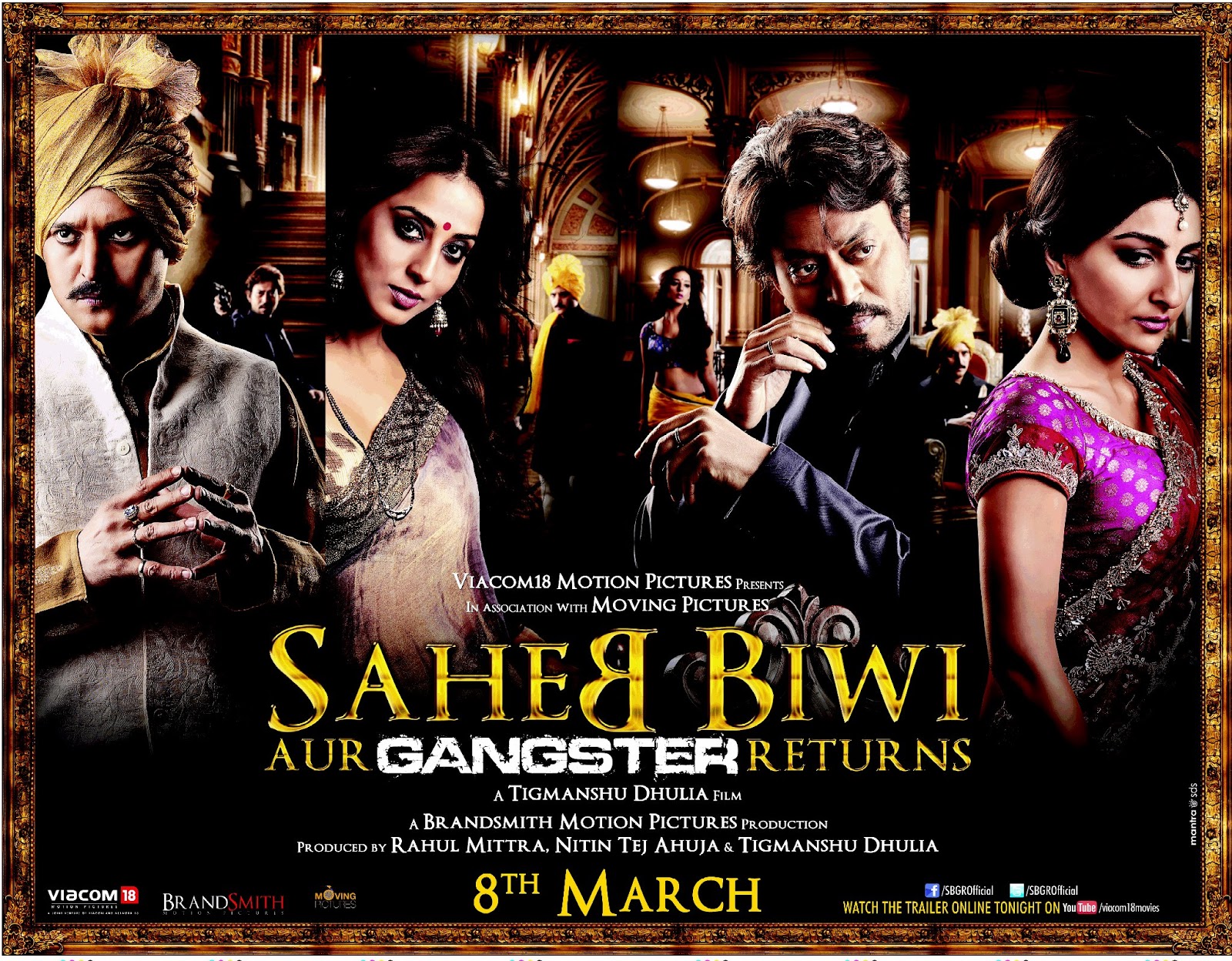
Between Saheb Biwi Aur Gangster and its sequel that released yesterday, a lot has changed for Tigmanshu Dhulia. First and foremost, he has become a known face, thanks to his negative role in last year's Anurag Kashyap epic Gangs of Wasseypur as Ramadhir Singh. And how could anybody forget Ramadhir's comment, "Jab tak iss desh mein saneema hai, public c****ya banti rahegi." On that background, Saheb Biwi Aur Gangster Returns is a treat for all the cine-phile c****yas.

Set on the backdrop of the division of Uttar Pradesh, the film uses the political scenario as a subplot to engage you in a war that is very personal. Picking up from where he left in the first film, Tigmanshu begins the sequel with wheelchairridden Saheb; who intends to marry Ranjana (Soha Ali Khan), a Rajput heiress, for progeny. Ranjana however, is in love with gangster Indrajeet Singh; whose aim is to avenge his family's lost heritage by killing Saheb. On the other side is the biwi, Madhavi Devi (Mahie Gill), a puppet MLA, trying hard to play the game by her own rules. By now, you find yourself in a web of interpersonal conflicts and as the film progresses, you only go deeper into this web, which then consumes you.

Unlike the first part, this film has no shortage of great performances. Irrfan Khan, who has worked with Tigmanshu in Paan Singh Tomar, continues charming audiences with his act as a Rajput. Jimmy Sheirgill puts in a brilliant performance and outlines the journey of Saheb as he reemerges to power with the right amount of conceit and flamboyance. Mahie Gill fits the bill as the neglected, disrespected wife; but it is sad to see her getting typecast in such roles. Soha Ali Khan pitches in with what is perhaps her best work on the screen and Pravesh, who makes his debut, is a little stagnant but bearable.

The film is composed brilliantly with specific motifs for every character and scores full marks on its microstructure. Unfortunately, what the film lacks is the same elements that were missing in the previous film too. The music is just not up to the mark. An unnecessary item number by Mugdha Godse does nothing but add to the duration of the film and another song in the film simply reminds you of Aarambh from Gulaal. If you cover your ears a little and ignore the lyrics, you will find the similarities.

The second shortcoming is the production value of the film. In some places, the costumes just don't look royal enough and create a paradox. However, made on a comparatively low budget, the film does convey a lot through its sets, which stand for the fallen prestige of India's royal families.

Through Saheb Biwi Aur Gangster Returns, Tigmanshu Dhulia brings you a thriller, political drama with a grownup romance and a tale of heartbreak at the bottom of it. The film makes you identify with the characters, take sides and as it progresses, introduces a predicament which may make you want to change sides. Engaging to say the least, this will go down as one of this year's better Hindi films.


Rating - 3.5 out of 5


Published in DNA After Hrs (Pune) on March 9, 2013


Saturday, November 24, 2012

Closer to God

Based on Yann Martel's bestselling "unfilmable" book, Ang Lee's Life of Pi is perhaps the most advanced adaptation of any literary work. For everyone who has read the book, the film is not a barricade to imagination, but a near-perfect transcription of words to screen. The primary hook is the 3D which pulls you into what is perhaps the most terrific story you have ever willingly believed. 


Life of Pi is, as the title suggests, the story of Pi Patel who is born in Pondicherry to a zoo keeper. The unusual childhood with an unusual name comes to an end when the family decides to move to Canada for a better future. Pi, therefore, finds himself along with all the animals from their zoo and his family on a Japanese freighter. The ship sinks in a storm in the Mariana trench and Pi survives the disaster alone and finds himself stranded on a lifeboat with a Zebra, an Orangutan, a Hyena and a massive Bengal Tiger named Richard Parker. Thrust into adventure and a battle for survival, Pi finds more answers to life in the 23 days of isolation than he did in his quest for answers in his entire childhood. Having survived the journey, Pi is a different person with a brand new perspective on life, death and all that it contains. 

The story is narrated by a grown up Pi (Irrfan Khan) to a writer. On one level, the entire journey that seems extremely incredible and unbelievable appears true for the visuals that depict the story throughout the film, and are by far the best we have seen on screen. Ang Lee's technical proficiency is seen in every single frame and the film is by far the best 3D experience one can have. It is hard to distinguish shots with real animals from the ones with their digital renditions which must have made it hard to convince animal rights activists that none were harmed. 


Claudio Miranda's hold over the cinematography, especially the camera movements in 3D and the composition of shots is exquisite. Come to think of it, for most part of the film, the frame only has water, a boat, a man and a tiger. To keep the audience gripped is quite a challenge. That challenge was unarguably made easier with a little help from the music composer Mychael Danna. Suraj Sharma, who plays Pi in the journey has great screen presence and drives the narrative forward while you are busy witnessing the powerful imagery. On the other hand, Irrfan Khan, the narrator and the Pi of the present, has made hay of all the screen time he has and helps you through the end with an incredible monologue of sorts. 

In the film, Pi claims that his story would bring the listener closer to god. If you believe in god, or whatever it is that you believe has superior power over the universe, you will not disagree. The final twist in the plot where this entire journey is seen with a different perspective of the same person who first told it, is a groundbreaking thought for all story-tellers of our time. The emotion of the survivor about the outcome of the journey being the same, no matter how it happened, makes you question a lot of things. 

What this film can boast about is that it makes you think about how you have lived thus far and how you want to live here onwards. Very few films and works of art in general, have the capability of becoming a milestone, a landmark by which your life is measured on a before-after scale. Life of Pi is one of those films.


Rating - 4 out of 5

Published in DNA After Hrs (Pune) on November 25, 2012